A batch record that leaves room for a correction
A revised batch-record sheet is being used in Caldrin's teaching bakehouse this fall. The change is small: a correction now has its own dated note, and a missing observation remains marked as missing. For students preparing a production portfolio, that distinction helps separate what was known during a session from what was clarified afterwards.
From the college
A revised batch-record sheet is being used in Caldrin's teaching bakehouse this fall. The change is small: a correction now has its own dated note, and a missing observation remains marked as missing. For students preparing a production portfolio, that distinction helps separate what was known during a session from what was clarified afterwards.
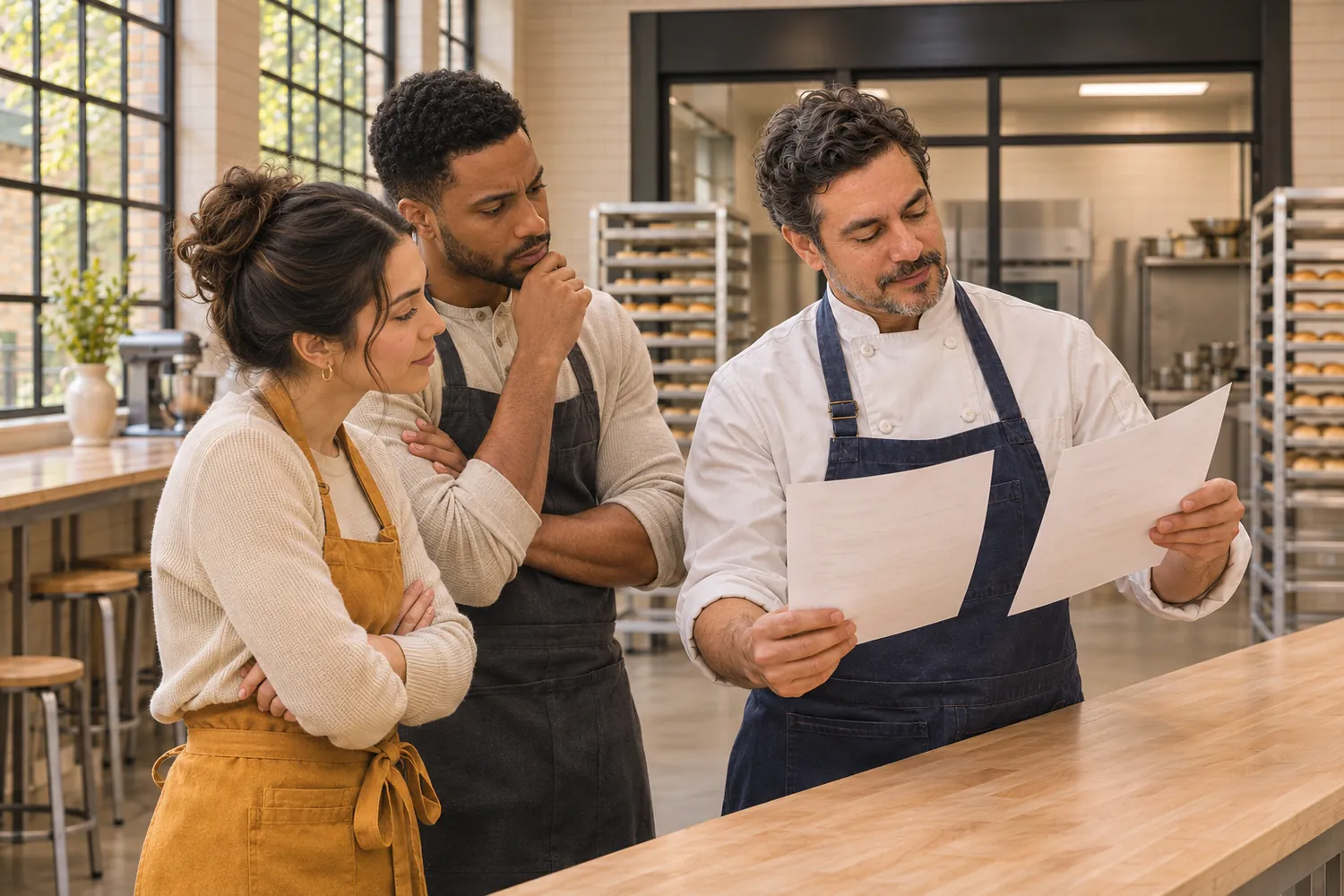
Chef Mateo Sanz introduced the sheet during the opening record workshops. Students compared two original teaching examples: one in which an earlier quantity had simply been overwritten, and another in which the original figure remained visible beside a reasoned correction. The second example was longer, but another learner could explain where the final value came from.
The exercise connects to Batch Records and Scaling. Its first task is to align the quantity, unit and batch identifier before a calculation is compared with another row. A correct multiplication cannot repair an uncertain source quantity. The workshop therefore asks students to identify questions before attempting to complete every blank on the form.
The new layout keeps planned, produced, accepted and excluded counts separate. An accepted item means one that meets the stated criteria of a particular classroom exercise. It is not a claim about saleability, food safety or a customer's preference. Instructors define the criteria and the scope of each task before students use the record.
For a portfolio, learners retain the original brief, the source rows, the correction and a short explanation of what the revision changes. The college does not ask them to make an archive look flawless. A visible uncertainty can be more informative than a neat total whose origin has disappeared.
The same approach appears in Practice Stories, where original simulated records accompany each case. Exact values are available as readable tables and downloadable source files. Photographs show the instructional setting and the people discussing the work, while the source records carry the precise quantities and comparison notes.
Students who need help checking units or explaining a revision can bring the assignment brief to Learning Library. The support conversation can examine a calculation or a paragraph without completing the assessed work for the learner. Library hours and individual tutoring arrangements are listed separately.
The next review of the sheet will consider whether a learner unfamiliar with the session can trace one changed value. That question offers a clearer test of the document than simply asking whether the page looks more professional. Teaching Kitchens will collect classroom feedback before making a further version change.