Six Batches, One Record
The product, document or result is one part of the story. Inspect the source record and the decision behind a specific revision.
Tomas Velasco
Second-year AAS student
BAK 210 · Bread Quality Records
Adviser: Chef Mateo Sanz
Original simulated teaching case
The question and the learner
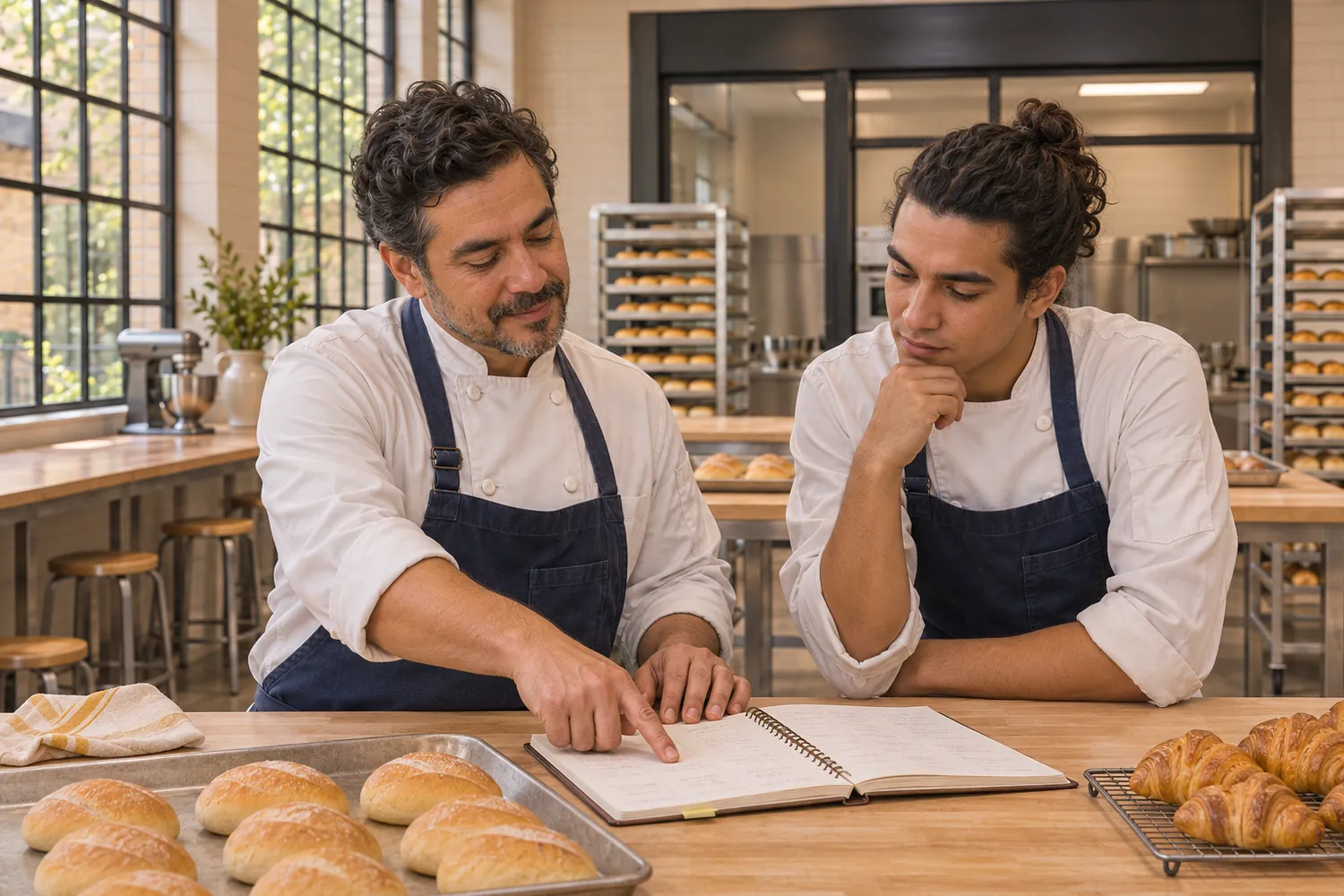
Tomas Velasco's six-batch review began with an attractive group of products and a notebook that was harder to compare than he expected. Each fictional batch had a planned count of twenty-four. The product observations were useful, but the first three entries did not preserve a mixing-record time. Chef Mateo Sanz asked Tomas to explain which comparisons were still possible and which tempting explanations the missing field made impossible to test.
The task belonged to Bread Quality Records, where a learner must describe products against explicit teaching criteria and retain the identity of every batch. The review did not require a scientific claim about a formula, a fermentation schedule or a safe production process. All batches and observations in this case were authored as a classroom scenario. The values let a reader inspect the reasoning without confusing an illustrative photograph with a controlled experiment.
Original records and the comparison
Tomas first gave the six source rows permanent identifiers B01 through B06. The planned and produced counts are twenty-four for every row. The accepted counts are twenty-three, twenty-two, twenty-four, twenty-three, twenty-four and twenty-three. Subtracting accepted from produced gives one, two, zero, one, zero and one exclusions. Across the six rows, the teaching record therefore contains 144 produced items, 139 accepted items and five exclusions. Those totals can be checked directly in the accompanying CSV.
The word accepted has a limited meaning here. It refers to the stated shape criteria of this instructional exercise. It does not certify food safety, nutritional quality, saleability or a customer's preference. The first, second, fourth and sixth records describe one or two items outside that exercise criterion. The other rows record no such exclusions. Keeping that definition next to the count prevents the chart from presenting a narrow classroom judgment as a broader product-quality guarantee.
The source package preserves unknown for the mixing-record times in B01, B02 and B03. Later rows contain 08:40, 08:45 and 08:50. Tomas does not fill the missing fields from memory or infer a time from the appearance of a product. An empty observation is not a zero-minute interval, and it cannot establish that an earlier batch followed the same schedule. The gap remains visible in the revised table as a question the current record cannot answer.
Complete original simulated source records · Scroll within the table on a narrow screen.
| Batch Id | Planned Units | Produced Units | Accepted Units | Excluded Units | Mix Record Time | Observation |
|---|---|---|---|---|---|---|
| B01 | 24 | 24 | 23 | 1 | unknown | One item outside the exercise shape criterion |
| B02 | 24 | 24 | 22 | 2 | unknown | Two items outside the exercise shape criterion |
| B03 | 24 | 24 | 24 | 0 | unknown | All items met the stated exercise criteria |
| B04 | 24 | 24 | 23 | 1 | 08:40 | One item outside the exercise shape criterion |
| B05 | 24 | 24 | 24 | 0 | 08:45 | All items met the stated exercise criteria |
| B06 | 24 | 24 | 23 | 1 | 08:50 | One item outside the exercise shape criterion |
Revision, limits and the next question
His first draft grouped photographs by color and used the grouping to suggest why certain items had been excluded. Mateo asked him to remove that inference. Lighting, framing and display choices can make images useful for describing a teaching scene, but they do not repair absent process records. The revised comparison uses a count chart with the same identifiers as the source table and a written account of the criteria. Images accompany the explanation without carrying exact quantities.
The document change is deliberately small: a required record-time field, a named observer, a criterion note and a distinction between missing information and an observation of no exclusions. A future blank form includes these fields before a new session begins. The corrected archive does not pretend that the new form was used for the first three batches. Both the old omission and the planned change are part of the evidence of learning.
Tomas's portfolio also includes a reconciliation line. Accepted plus excluded must equal produced, and produced is compared separately with planned. If a later batch produces fewer items, the difference must not be hidden inside the exclusions column. The simple equality is useful because it reveals a counting problem without offering a causal explanation for it. A well-structured table supports better questions; it does not automatically explain why a product differed.
The next supervised exercise would use the revised form from the beginning and retain the same observation criteria. Tomas would compare the completeness of the records before deciding whether a further question could be examined. Even then, a small set of teaching batches would not support a universal production rule. The outcome of this case is a readable archive, a justified correction and a more modest claim. That is enough to make the next learner's work easier to inspect and continue.
For a peer review, Tomas prepares an unfilled copy of the revised form and an example containing one deliberate missing field. The peer must identify the gap and describe its consequence without guessing a replacement. This task checks the record structure, not a production technique. The final portfolio retains the peer question and Tomas's response, so an assessor can see why the additional field was chosen rather than assuming that more columns always produce a better document.
Complete source package
The downloadable text contains the full case, every original source row and the expected reconciliation. CSV contains the same complete table. These files are learning materials, not business records.