Batch & Cost Workshop
Inspect and change a transparent material-cost scenario, then download its records.

The original material table
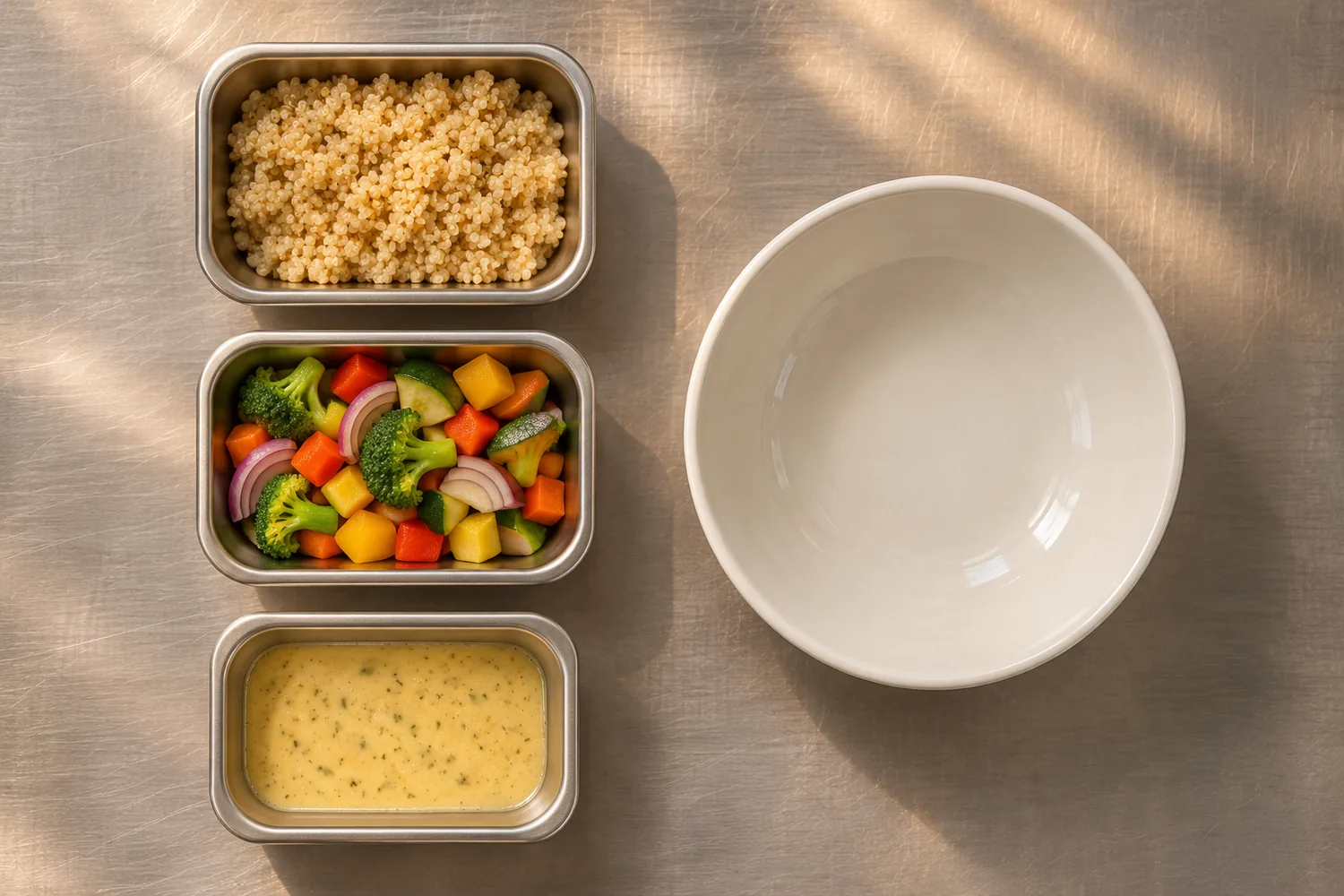
This grain-bowl illustration uses invented per-portion net quantities and price assumptions. It is not a cooking instruction, purchase order or supplier quote. Keep the unit of mass beside the price unit before making a comparison.
Original simulated teaching inputs · Scroll within the table on a narrow screen.
| Component | Net grams per portion | Price cents / kilogram |
|---|---|---|
| Grain base | 80 | 320 |
| Vegetable mix | 140 | 280 |
| Dressing component | 25 | 640 |
At twenty-four portions and zero loss, net quantities are 1,920, 3,360 and 600 grams. Rounded ingredient lines are $6.14, $9.41 and $3.84, giving $19.39 total and $0.81 per portion. The unit figure is rounded after summing the lines.
Try a different assumption
A materials-only exercise.
No order, inventory or business decision is made.
Formula and rounding
Planned purchase quantity equals net quantity per portion multiplied by portions, divided by one minus the loss fraction. Ten percent loss uses a divisor of 0.90; simply adding ten percent does not represent the same assumption. Convert grams to kilograms, multiply by cents per kilogram and round each line to the nearest cent, half up. Sum the rounded lines, then divide by portions for the rounded unit amount.
At twenty-four portions with ten percent loss, the three planned purchase quantities are approximately 2,133.333, 3,733.333 and 666.667 grams. The rounded lines are $6.83, $10.45 and $4.27: $21.55 total, $0.90 per portion and $2.16 above the zero-loss illustration.
What the comparison leaves out
No labor, tax, fixed cost, nutrition, safety, available stock, order submission or actual profit is represented.
The same gram quantity cannot silently become a purchased pack count. Real pack sizes, actual stock and approved purchasing arrangements would need separate records. A material contribution is also different from profit: labor, premises, tax and demand remain outside this exercise. The related Practice Story identifies its own rounded unit allowance explicitly rather than overwriting this exact batch total.
Purchasing and stock as learning
Preparation & Stores Room supports supervised quantity and issue/return work. Students retain the identifier and reason for a correction, distinguish a missing count from zero and name who owns the next check. Only staff authorize access or a tool issue. The worksheet CSV keeps assumptions and exclusions with the result; it cannot reserve stock or instruct a supplier.
Learning in context