A Menu with a Limit
The product, document or result is one part of the story. Inspect the source record and the decision behind a specific revision.
Sienna Cole
Second-year AAS student
CUL 210 · Menu Production
Adviser: Chef Leona Price
Original simulated teaching case
The question and the learner
Sienna Cole began with a menu that looked affordable because its selling-price assumption was easy to remember. The teaching brief allowed twenty-four grain bowls, three component groups and a short service exercise. It did not ask her to establish a viable business. Chef Leona Price asked a narrower question: could another learner follow the quantities, understand the difference between planned and served portions, and identify which costs had actually been counted?
The original menu sheet named the components but placed a single estimated cost beside the finished bowl. Sienna could explain the appearance she wanted, yet the sheet did not reveal whether the estimate used kilograms, grams or whole purchase packs. Someone changing the portion count would have had to guess. The first revision therefore happened before another product was made. She gave each component a net quantity per portion and kept the corresponding price unit alongside it.
Original records and the comparison
The source table contains eighty grams of grain base, one hundred and forty grams of vegetable mix and twenty-five grams of dressing component for each planned portion. At twenty-four portions, the net quantities are 1,920, 3,360 and 600 grams. The invented prices are 320, 280 and 640 cents per kilogram. Each quantity is converted to kilograms before multiplication. Rounding each line to the nearest cent produces 614, 941 and 384 cents, for a total ingredient illustration of 1,939 cents.
That calculation describes the defined net ingredients. It does not include an allowance for purchase loss, pack sizes or an actual supplier order. Those questions can be explored separately in the batch-cost worksheet. Keeping them outside this first comparison makes the meaning of the number easier to inspect. Sienna's corrected sheet states the exclusions beside the total, rather than leaving a reader to discover them in a footnote after drawing a larger conclusion.
During the fictional exercise, twenty-two portions are recorded as served and two as unserved. Both counts belong in the record. Dividing the material total by the planned twenty-four portions gives about eighty-one cents per planned portion; allocating the same total across twenty-two served portions gives about eighty-eight cents per served portion. The second figure is not evidence that the recipe changed. It is a different denominator answering a different question about the same bounded teaching run.
Complete original simulated source records · Scroll within the table on a narrow screen.
| Component | Net Grams Per Portion | Planned Portions | Net Grams | Price Cents Per Kg | Line Cost Cents |
|---|---|---|---|---|---|
| Grain base | 80 | 24 | 1920 | 320 | 614 |
| Vegetable mix | 140 | 24 | 3360 | 280 | 941 |
| Dressing component | 25 | 24 | 600 | 640 | 384 |
Revision, limits and the next question
Sienna also separates an invented selling-price assumption from an observed commercial sale. At 650 cents for each of twenty-two illustrated served portions, the scenario revenue is 14,300 cents. Subtracting the 1,939-cent material illustration leaves 12,361 cents of material contribution. It is not net profit. Labor, premises, equipment, tax, payment costs and demand have not been modeled. A numerical margin can be correct while still being too incomplete to support an enterprise decision.
The practical change is a short reconciliation at the end of the sheet: planned portions, served portions, unserved portions, the reason recorded for a difference, and the person responsible for the next review. In this original scenario, no claim is made about whether unserved food could be reused. That would depend on a separate instructor-controlled process. The learning task is to preserve the count and the unanswered question, not use a budget exercise to make a food-safety judgment.
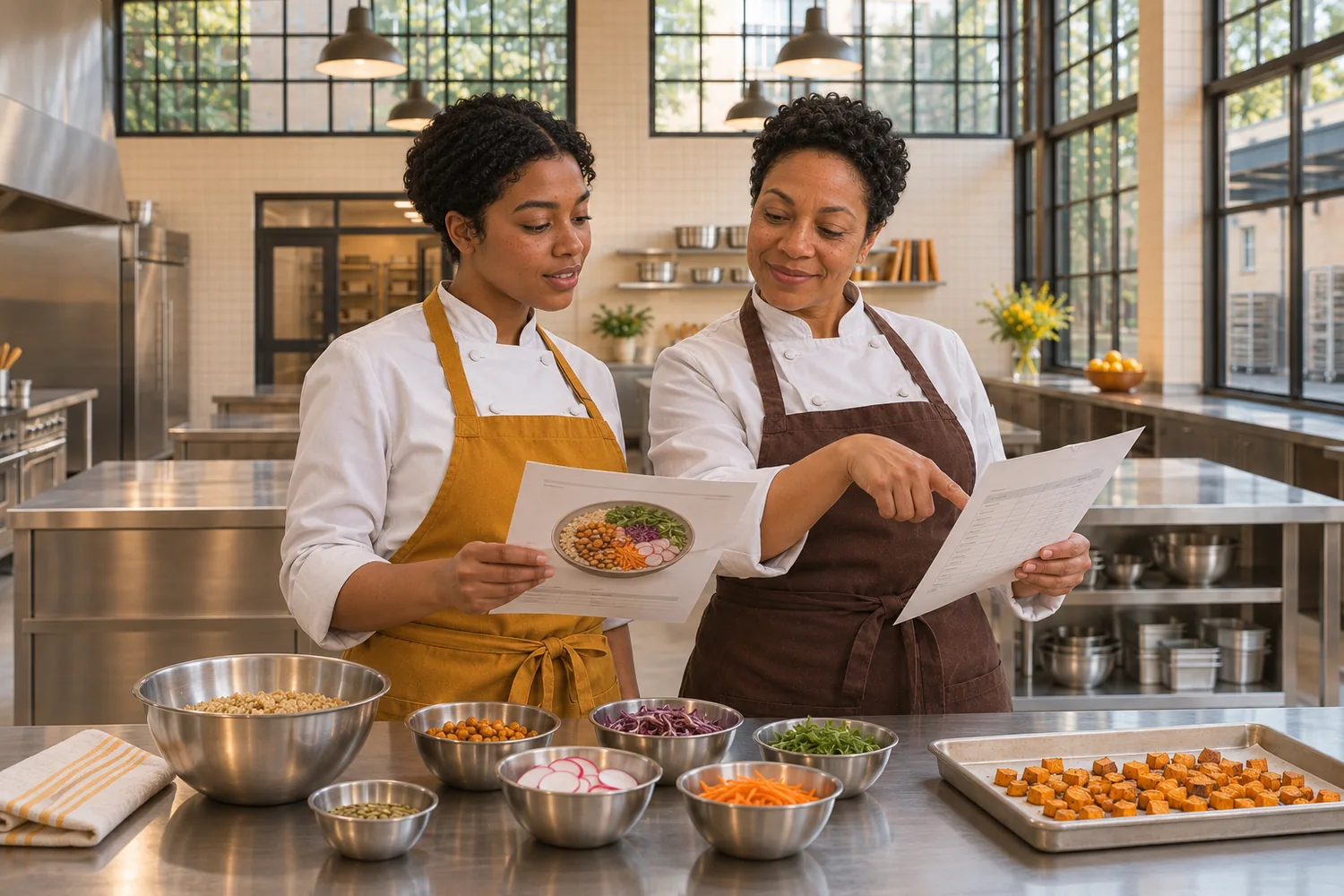
Leona's feedback concentrates on what a second learner can reproduce. The revised sheet keeps the source quantities, the unit conversion, the line rounding and the final denominator visible. A reader can check the arithmetic without treating the illustrative photograph of the bowl as a measuring instrument. The image shows the teaching context, while the table and downloadable source package carry the exact values and the distinction between a plan and its illustrated outcome.
For the next class discussion, Sienna proposes comparing the same twenty-four-portion plan with a ten-percent material-loss assumption. She will not change the selling price at the same time, because doing both would obscure which assumption changed the answer. The worksheet uses net need divided by one minus the loss rate. Its result remains a purchasing illustration, not an order or a complete operating budget. The next useful step is another transparent comparison, not a claim that one brief exercise has settled the menu's commercial future.
The teaching review includes a final distinction between a serving count and a sales count. In this authored exercise they are aligned for a transparent illustration, but a real operation could contain complimentary portions, returns or other categories. Sienna records that simplification rather than extending the table with invented detail. A later exercise could add those categories explicitly. Until then, the stated twenty-two served portions are the denominator for this one comparison and nothing more.

Complete source package
The downloadable text contains the full case, every original source row and the expected reconciliation. CSV contains the same complete table. These files are learning materials, not business records.